Tuesday, March 8, 2016

Buying Bulk Stock Products (Off Shelf) from China

You are reading ChinaImportal's Newsletter!


off shelf bulk products

Planning to buy bulk stock products from wholesalers in China? Depending on your industry, and target market, buying off shelf goods may be a dead end. ‘Make to order’ is the standard mode of operations when outsourcing production to manufacturers in Asia. Manufacturing is a risky and time consuming process, so wouldn’t it just be a lot easier to buy goods that are already available in stock?
The answer is sometimes yes, but mostly, no. Whether or not off-shelf procurement is a viable strategy, depends on various factors, including the type of product, and your market. This, and much more, is explained by Zhu Jing, Co-founder of Jingsourcing.com. But first, I’ll get you updated on the basics.

Part 1: What Importers Must Know About Buying Bulk Products

Manufacturers in China, and most other places in Asia, operate according to a ‘make to order’ principle. This means that the supplier doesn’t keep products in stock. In fact, most suppliers don’t even keep raw materials and components in stock. Instead, they procure the necessary raw materials, from their subcontractors, as it’s needed to produce goods for their own customers. At least, this is how it works for goods made for export markets.

But what about all those online wholesalers and traders, selling bulk stock products? Yes, they exist. However, they are primarily selling goods made or the domestic Chinese market. This is problematic, for the reasons explained below:

1. Off shelf products, made for the domestic market, normally don’t comply with overseas labelling requirements. In the United States, for example, all products must be marked with the Country of Origin (i.e., Made in China). There are other labelling requirements that apply to specific categories. For instance, apparel importers must ensure that care labels, sizes and the fiber descriptions are compliant with local labelling requirements.
2. Products, made for the domestic market, are not made to comply with overseas safety standards. While China has it’s own product compliance marks (i.e., CCC mark) and standards, these are not interchangeable withforeign compliance marks (i.e., FCC and CE) and safety standards.

Part 2: Interview with Jing Zhu of Jingsourcing.com
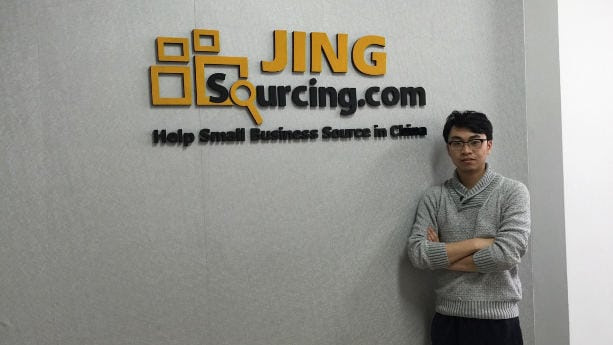
Zhu Jing

You are working with small buyers worldwide. Are they normally interested in buying custom made products, or ‘off shelf’ goods?

People have different definitions for what a “small business” really is, so I’d like to start out with clarifying what we consider being a small business. Here it comes: We define “Small volume buyers” as a business with a total order value of less than US$2,000. That includes different SKUs. Thus, different products, not just one.
For these buyers, they normally have no other option but to buy, what you now call, bulk products. That’s because customization results in a higher Minimum Order Quantity (MOQ), not only for the product itself, but also for the packaging. There are also tooling costs. If you need your own design for, say, plastic products, you’ll need to invest thousands of dollars in an injection mold.

So, what is the ‘breaking point’ for when you should consider buying ‘newly produced’ goods?

Other small businesses that buy more than just US$2,000 per SKU (not mixed orders), tend to at least procure custom printed packaging, with their company information and artwork. Sometimes, they may also buy custom designed product. These products are “newly” made to order, which is how it usually works.

How common is it that Chinese factories actually keep a stock of products?

In my honest experience, and I am born and raised in the factory landscape in Zhejiang province, factories don’t keep more than goods worth a thousand US dollars. However, say that it’s a really low value product (like $1 per pc), most suppliers will not have 1000 units ($1000 worth of goods) in stock. There are, however, two exceptions to this rule:

1. The supplier may have ‘over produce’ from previous orders. Thus, they may want to sell this to other buyers.
2. There are defect products in stock, that has been refused by previous buyers.
Editor’s note: There are some exceptions, with suppliers that are to a certain degree specialize in offering “off shelf goods”. However, tread carefully, as I certainly agree that the vast majority of off shelf goods belong to the two categories above.

But, aren’t most off shelf products made for the domestic Chinese market?

There are “stock” products, made for both the domestic Chinese market, and overseas markets. Off the shelf products are often daily usage commodities, that aren’t subject to much development. These are products that stay the same. Hence, the produce can in some cases be used for both the domestic market in China, and export.

Are importers in some countries more prone to avoid “Off shelf” products, than others?

Yes, there are trends. For example, Importers from the United States and Europe are more likely to order custom designed products. At the very least, US and EU importers design their own packaging, with their own artwork, logo and company information. It’s also common that they brand the product, even if it’s not their own design. It’s called private labelling, as you might already know. This is the case even for small businesses.

Buyers from Asia, South America and Africa might be a bit less focused on branding. In my experience, mass produced products are mainly exported to developing markets. Maybe because it’s still possible to run a good import business in these countries, selling generic goods, without branding or customisation. But, I think in the years to come, more and more businesses from these emerging markets will realize the benefits of customisation and branding. They will start thinking in the same terms.

Now, take a ‘ready made’ toy for example. Children’s products and other toys are regulated, for example, by CPSIA in the US and EN 71 in the EU. Toys ‘made for China’ are not manufactured according to these regulations. Hence, this makes it practically impossible to buy, for example, off shelf toys from China?

Yes, that is correct. Please let me develop this further. Product safety standards and procedures exist in China, but it’s an area that is still developing, and moving quite fast. It can be hard to keep track sometimes. So, what this means is that toys, for example, are not always reaching the substance and safety requirements in the EU and USA.

I can tell of an example. Inflatable rubber horses. Those that kids like to ride on in the pool. The very same design, ‘newly produced’ for the EU or US market, is 35% more expensive than a unit made for the Chinese market. It’s not that the quality, in terms of what it looks or feels like, is different. The difference is that US and European importers cannot buy products made of materials that is, for example, phthalate free. Or, heavy metals free.

As of now, EU and US safety standards are higher than domestic ones. This is important, because a lot of off shelf products out there are made for the domestic Chinese market.

So, when is it right to buy Off shelf products, and when should buyers consider other options?

Products that are not as strictly regulated, like packaging, gifts, crafts, household goods. These are far “easier options”. Products that are strictly regulated, like electronics and toys are very hard to buy in small volumes. There is a risk that importing these products can result in the shipment being seized by customs in the buyer’s country, if they don’t have the valid compliance documents, like certificates and test reports.

You are the co-founder of Jing Sourcing, based in Yiwu. What can your company do for businesses looking to buy Off the shelf products?

From our office in Yiwu, we help buyers, from the whole world, to source products from both manufacturers and the local market. As some of you may know, Yiwu is famous for its wholesalers and ‘off the shelf’ bulk product traders. As such, we can serve the needs of many types of buyers, including those that are looking to buy for less than US$1,000 per SKU.
However, our methods are of course very different when it comes to products that are more regulated, for example Toys and Electronics. In these cases, we assess the supplier’s capability to ensure compliance with relevant safety standards and regulations. We can also manage other procedures, for example administering samples and compliance testing.


We can help you to supply Halal Dairy products such as Cheese, UHT Milk etc.

Contact us:

+60126694217
Email: rijal33@gmail.com


Monday, February 29, 2016

Importing Furniture from China in 5 Steps

You are reading ChinaImportal's Newsletter!


White Barcelona chair

About to purchase furniture, or other home products, from suppliers in China? Keep reading, and learn what you must know about finding the right furniture suppliers, relevant trade shows and customization options. We also explain what furniture importers must know about fire retardancy regulations, quality control and shipping.

1. Finding the right Furniture Manufacturer in China

When sourcing Furniture manufacturers online, there’s a variety of factors to use when assessing potential candidate suppliers. Below follows a few examples:

Registered Capital: A low registered capital may indicate that the supplier is a small trading company. As there are no real benefits of buying from a trader, you want to avoid that. A Furniture manufacturer should have at least RMB 1,000,000 in registered capital, which is specified in their business license.

Business Scope: Possibly even more telling than the Registered Capital, the Business scope explains what the company was set out to do. Look for “furniture” and “manufacturing”, or “production”, to assess if the supplier is a true manufacturer. Traders, on the other hand, tend to have business scopes, including a wide range of very different products, and include terms such as “Wholesale”.

Quality Management System: A Quality Management System, for example, ISO 9001, is implemented to track and prevent quality issues. Why does this matter? Because it only applies to manufacturers, not traders.
When buying furniture from Chinese suppliers, why is it important to first filter suppliers? Because the majority of Furniture manufacturers are not geared towards developed markets, offering the quality options and stability you need to compete.
If you don’t feel like browsing supplier listing online, you may want to consider visiting a Home products trade show in Mainland China or Hong Kong. Below follows a summary of relevant, annual, trade fairs in the Furniture and home products industry:

Globalsources Gift & Home (Hong Kong S.A.R)

  • Home Living & Decor
  • Kitchen & Dining
  • Home Improvement

Canton Fair (Phase 2) (Guangzhou, Guangdong)

  • Bathroom Furniture
  • Outdoor Furniture
  • Office Furniture
  • Hotel Furniture
  • Living Room Furniture
  • Household decoration

HKTDC Hong Kong Houseware Fair (Hong Kong S.A.R)

  • Artificial Flowers
  • Hardware & DIY Products
  • Bar Accessories
  • Health & Personal Care Items
  • Bathroom Accessories
  • Home Decorations & Handicrafts
  • Kitchenware & Gadgets
  • Cleaning & Supplies
  • Eco-Friendly Products
  • Silver Generation Products
  • Small Electrical Appliances
  • Gardening & Outdoor Accessories
  • Tableware

2. Furniture Customisation Options

What differs a retailer, or even wholesaler, from an OEM manufacturer? When you buy a product from a retailer, take Ikea for example, you know that their products are made according to the very same specification sheet. There is no variation in terms of materials, design, dimensions and functions. Yet, many importers of home products, including furniture, make the assumption that this is how OEM manufacturers in China, also operates.

OEM manufacturers operate according to a ‘make to order’ principle. While they may have “catalog products”, these are mere references, at best. What this means for you, is that you must provide the supplier with a spec sheet – even if the product is based on a factory design. There is no uniform Furniture spec sheet template that can be used. However, below follows a few examples of what you must include in your specification sheet:
  • Wood Quality (i.e., German Beech Wood)
  • Fabric Specifications (i.e., PU Coated Polyester, 550 gsm)
  • Metal Parts (i.e., 316L Stainless Steel)
  • Foam (i.e., High Density Fire Retardant Foam Rubber)

3. Assess Applicable Furniture Regulations

In many markets, there are mandatory Fire Retardancy Regulations, applicable to various types of furniture. In the United States, there’s no federal framework to which American importers must comply. However,California Technical Bulletin 117 (TB117) has become ‘de facto’ mandatory, as it is asked for by both retailers and customers.

However, In the European Union, there are mandatory Fire safety standards, to which buyers are forced to comply. Below follows an overview:
  • EN 1021-1
  • EN 1021-2
  • EN 597-1
  • EN 597-2
  • EN 14533
Keep in mind that you must communicate to the supplier, to which standards your product must be complied with. A few years ago, I remember how we performed a quality inspection on upholstered furniture in Hangzhou. As we started testing the fire retardant of the cover fabric, it turned out that the goods were in no way going to pass a third party audit.

However, the present sales manager, quickly brushed off any responsibility. Instantly, he underlined that they are indeed capable of ensuring compliance with all European and American substance and fire retardant standard, but that this customer did not communicate that their product had to be compliant with a certain standard.

Hence, the procurement officers, working in the factory, did not make this specific request to their subcontractor for cover fabrics… and indeed, they didn’t ask either, so the result was a batch of a non-compliant goods. As such, you must first assess which regulations apply to home products in your market, and then communicate this requirement to your manufacturer.

4. Quality Control

To ensure that your supplier is not shipping substandard or damaged goods, which is perfectly possible, you must hire a quality inspector to check up on the goods. There are several companies offering quality control services, already in China. However, you need to communicate what they should look for. Below follows explanations of two of critical checkpoints, when importing furniture from China:

Visual Inspection: Check for potential damages, or usage of incorrect materials and components.
Fire retardancy testing: While most compliance tests can only be carried out in a laboratory, fire retardancy of fabrics can be checked just as well with a lighter and a stopwatch.

5. Shipping & Logistics

Furniture is heavy, and can easily break under the weight of stacked units. Many manufacturers understand this, while others routinely fail to apply common sense when packing furniture. As such, I suggest that you request packing, as following:
  • Outer Cartons with plastic wrapping (to prevent mold)
  • Pallets (for easy unloading)
As furniture is not only heavy, but also taking up quite a bit of space, most buyers in this segment base their imported volumes on a container basis, rather than a unit bases. Hence, request your supplier to quote a volume based on an FCL 20’’ or 40’’ HQ container, and let them specify the number of units that can be loaded in each.


Call us or Whatsapp us : 
we here at Alveo Legame can help you and your business grow.

+60126694217
alveolegame@gmail.com


Monday, February 22, 2016

Product Import Budget Calculation: A Case Study

You are reading ChinaImportal's Newsletter!


Procurement Budget


Making a Product Import Budget Calculation is the first step before investing in a new venture, or product. However, it’s far from as easy as simple as counting a profit directly on a quoted FOB price. In this article, we show you what an Import Budget Calculation might actually look like. As costs vary depending on a several factors, such as product, imported quantity, destination and mode of transportation – we have made the following assumptions:
  • Product: Wristwatches
  • Quantity: 3000 pcs
  • Pre-production sample required: Yes
  • Transportation: Air freight
  • Third party service provider assistance: Essential services only
  • Destination: United Kingdom
  • Targeted procurement price: $30
  • Estimated retail price: $220

1. Cost Overview

a. Product Costs

Unit Price
The unit price makes up a majority share of the total procurement budget. In order to obtain a unit price, you must first draft a product specification, which is the basis for your price research. For more guidance on how to manage price research in China, read this article. In this Case Study, we set the unit price at $19.6.

Product Packing
Product Packaging is another cost to take into consideration, when making calculations for an import budget. The product packaging cost varies, depending on the materials and the quantity. However, in this Case Study, we assume a cost of $1.85.
Pre-Production Samples / Tooling Costs
While a product sample, or prototype, is a non-recurring charge, it can still add on significantly to the startup cost of launching a new product. However, as this Case Study is based on Wristwatches, we can assume a relatively low pre-production sample and tooling cost, of $640.

b. Third Party Service Costs

Supplier Sourcing & Due Diligence
Manufacturers in China are not created equal. They all have different track records, qualifications and technical expertise. As explained in this article, there are various ways to assess suppliers in China. You may of course do it yourself, or you may hire an agent or service provider to do so for you. If you choose the latter, there is essentially no maximum amount of money that you can spend on conducting due diligence.
Hence, this may cost you anything from $200, to $2 million – depending on how “sure” you must be. However, in this article, we assume that you’ll be buying a Chinaimportal.com Industry Report, for a total cost of $349.
Quality Inspection
Buying from Chinese manufacturers is a bit like flying with a low cost airline. No extras are included. While many Chinese manufacturers indeed have their own, internal, quality management procedures – you must still pay a third party for an independent quality check on the goods. If you order a Quality Inspection from Sofeast.com, it’ll cost you $299. That also includes travel expenses.
Compliance testing
If you are based in the United States, the European Union or any other developed market, your product may be regulated by one or more product safety standards. Third party laboratory testing may, or may not, be mandatory. Regardless, non-compliance is by definition illegal, so you are strongly recommended to submit a pre-production sample for compliance testing. As this shipment is heading to the United Kingdom, we assume the following tests as necessary:
  • REACH: $720
  • RoHS: $420

c. Shipping, Duties and Other Taxes

Freight
For the sake of simplicity, we decided to assume that the shipment will be delivered by air freight. The cost of Airfreight is based on the following two factors:
  • Weight (Kilograms)
  • Volumetric Weight (Cubic meters)
Assuming a weight of 369 kgs, and a price per kilogram set at $5, we can add a cost of $1845, to our import budget.
Freight Insurance
The freight insurance cost usually as low as 0.5% of the freight cost. In this Case Study, that’s not more than $9.5. However, it is of some significance when calculating the Customs duties. As such, we decided it’s worth mentioning.
Import Duties
Customs duties vary depending on the product, and are calculated based on the Customs value – which in turn is based on the total value of Unit price, freight and insurance. This is what’s sometimes referred to as the CIF (Cost Freight Insurance) Price, a commonly used Incoterm. However, the method for calculating the customs value differs, but now the assumed destination is the United Kingdom, which applies the same customs value as the European Union as a whole. As such, we can now calculate the Customs Value as follows:
  • Unit Price (Including Packaging): $21.45
  • Freight (Per Unit): $0.615
  • Freight Insurance (Per Unit): $0.0036
  • Total Customs Value: $22.07
The duty rate in the UK, for watches, is currently 4.5%. Hence, we can now calculate an import duty of $0.993. Let’s just say $1, to keep things simple.
Note: The the value of the pre-production sample and/or tooling, may be included in the first shipment, or divided on later shipments. However, to not further complicate the calculation, we don’t add this cost.
Note: Importers in the United States and Australia, must only declare a customs value based on the FOB (Free on Board) value, which does not include the freight cost.
Value Added Tax (VAT)
The VAT is also calculated based on the customs value, plus the customs duty. In the UK, the current VAT rate is set at 20%. Hence, we need to add on another $4.6. Click here to read more about VAT, when importing to the United Kingdom, and other EU member states.
Note: VAT is only relevant to buyers in the European Union. Different taxes apply in, for example, the United States and Australia.

2. Import Budget Calculation

Cost
Calculation
Sub-Total
a. Product Costs
– Unit Price
$19.6 x 3000 pcs
$58,800
– Product Packaging
$1.85 x 3000 pcs
$5,550
– OEM Sample & Tooling Cost
$640
$640
b. 3rd Party Services
Supplier Sourcing & Due Diligence
$349
$349
Quality Inspection
$299
$299
Compliance testing
$720 + $420
$1,170
c. Shipping, Duties and Other Taxes
Freight
369 kgs x $5
$1,845
Insurance
$1845 x 0.5%
$9.5
Duties
($19.6 + $1.85 + $0.615 + $0.0036) x 4.5% x 3000 pcs
$3,000
VAT
(($19.6 + $1.85 + $0.615 + $0.0036) + $1) x 4.5% x 3000 pcs
$13,800
Total Investment
$58800 + $5550 + $640 + $349 + $299 + $1170 + 1845 + $9.5 + $3000 + $13800
$85,462.5
Unit Cost
$85,462.5 / 3000 pcs
$28.49
Note: The calculated procurement price, per unit, is below our target price. Hence, we can motivate the necessary investment.

3. Summary

This Procurement budget calculation only considers the most essential costs. That said, there is no universal method for outsourcing production to China, and, as such – the costs vary from case to case. Below follows an overview of additional costs, that you may need to take into consideration, when making calculations for your own import budget:
  • Business travel expenses
  • Social compliance audits
  • Design and engineering services
  • Legal assistance
  • Consultancy fees
  • Licenses and permits
  • Transaction fees


Talk to us about your business ventures ... we can bring you to the best sourcing place in China, Vietnam, Cambodia etc. Whatsapp: +60126694217 email us alveolegame@gmail.com


Monday, February 15, 2016

8 Tips for Successful Business Development

This post originally appeared on the American Express OPEN Forum, where Mashable regularly contributes articles about leveraging social media and technology in small business.
Many founders and CEOs come asking, “we need to hire a biz dev person, do you know anyone?” Few roles have more varied job descriptions than business development. It’s no wonder why it is hard to figure out who to hire, what this person should do and how to measure success. Read below for tips on successful business development for startups, including how to avoid many of the typical frustrations with business development.

1. Hire the Right Person at the Right Time

A person with deep industry knowledge and strong network ready to “do deals” can turn into a disaster if it is too early in a company’s product life-cycle. There are three stages in the commercialization process and not everyone is suited for every stage.
  • Scouting: The earliest stage of a company. At this point, business development is about identifying various routes to market, points of leverage and providing the internal team early market feedback. The ability to work with product and engineering teams is a key skill.
  • Testing: At this stage, biz dev will close a few deals to test assumptions and provide measurable input before you scale the business. Analytical skills to set up a framework for what to measure, and examining the data, will determine if and where to scale based on the company’s strengths and vision.
  • Scaling: After gathering data from early deals and validating a path to achieve your goals, business development is ready to start replicating deals and putting a support structure in place.

2. Business Development Is Not Sales

In general, business development will identify and create partnerships that enable leverage for driving revenue, distribution or that enhance the product. Sales is focused almost exclusively on driving revenue. Similar distinctions will apply when hiring a sales leader for an early stage company versus a more mature organization.

3. Post-Deal Management Is Crucial

All successful deals are a result of accountability and proactive management — by both biz dev and account management. In most cases, the account manager is a different person than the biz dev person who did the deal. Ideally, the account manager has variable compensation or incentives tied to meeting the goals established by both parties. If you are not ready to allocate the resources to support a deal, think twice before signing it.

4. Qualitative Versus Quantitative

Companies sometimes try to build a business purely around a qualitative value proposition, which is difficult and has a higher likelihood of failure. The market is less willing to pay for a better user experience or the promise of increased engagement, even if they like the product and find it useful. A quantitative value (lowers cost, drives revenue, more customers, etc.) dramatically increases the odds of success. One way to remember this rule is the pacemaker versus the hearing aid analogy: If you could only have one, which one would you choose?

5. Support for Business Development Is Essential

A good business developer will engage internal resources along the way to ensure the company can meet the goals and expectations of a partnership. A lack of support will almost certainly lead to finger pointing and blaming when things go south. Everyone should own part of the success or failure from the start.

6. Establish a Framework for Assessing Opportunity

In order to gain support from your team, everyone needs to understand why the deal makes sense for your company. Does it drive revenue, lead to new users or enable the company to enter a new market or vertical? When the goal is clear and measurable, it makes it easier to address issues like, “Why are we converting below projections?”

7. Make Deals Carefully

There is a difference between doing deals and doing the right deals. A good deal-maker can help identify a false signal –- when there is just enough market momentum and revenue to mask the greater opportunity. Conversely, a less experienced deal-maker or one with the wrong incentives can generate enough momentum and distract the company from the bigger opportunity. Many companies have been weighed down by a bad deal they later regretted -– this is where you want to develop a level of understanding and trust with your business development person.

8. There Are No Legal Issues

A legal agreement codifies a business arrangement and includes commercial terms as well as what happens if things do not work out. This requires business development and legal counsel to assess the business opportunity versus the business risk and explain the trade-offs to management.
Building a company is hard and requires a lot of things to go well including having a great product and team. Watching an idea become a product and a product generate revenue that becomes a successful company makes it all worthwhile. Bringing in the right business development person at the right stage, and following these other guidelines, will keep your company on the right track.

Outdoor Wear Manufacturers in China: A Complete Guide

You are reading ChinaImportal's Newsletter!


Outdoor wear suppliers

In this product guide, we explain what you must know before importing Outdoor wear from China. In similarity to our other apparel and textiles guides, this article will give you insights into Outdoor wear manufacturing clusters, product specifications and minimum order quantities. In addition, we also explain what you must know about relevant technical standards, labeling requirements and more.

Outdoor Wear Manufacturing Clusters in China

In recent years, Chinese outdoor wear manufacturers have faced increasingly tough competition from producers in other Asian countries. Primarily, Cambodia and Bangladesh. That said, as this industry is largely reliant on technical fabrics, which are also made in China, the country maintains a strong competitive advantage.
Most, exporting oriented, Outdoor wear manufacturers are located in the following cities and provinces:
  • Quanzhou, Fujian
  • Fuzhou, Fujian
  • Xiamen, Fujian
  • Jinjiang, Fujian
  • Shenzhen, Guangdong
  • Guangzhou, Guangdong
  • Suzhou, Jiangsu
  • Wuxi, Jiangsu
  • Hangzhou, Zhejiang
  • Ganzhou, Jiangxi
As you can see above, Outdoor wear buyers are wise to visit the southern, coastal, provinces of Fujian and Guangdong, as this is where most relevant manufacturers are based.

Outdoor Apparel Tech Packs and Material Specifications

China’s Outdoor wear manufacturers are OEM suppliers. Hence, you shall not expect a catalog with ready made designs for your selection. While most Chinese Outdoor wear suppliers do have such catalogs, they are to be considered for reference only. Most, so called, ODM (Original Design Manufacturing) products are designs ordered by previous customers. Hence, the suppliers rarely, if ever, have a full Tech pack.
Now that you know that you cannot rely on the manufacturer to provide you with a Tech pack, you need to know what to include in one, when importing Outdoor wear from China:
  • Design Drawings
  • Size Table
  • Bill of Materials (Component List)
  • Material / Fiber Composition (i.e., 98% Cotton, 2% Spandex)
  • Weight (i.e., 240 gsm)
  • Yarn Count (i.e., 40 x 40)
  • Yarn Type (i.e., Combed)
  • Colors (Pantone or RAL)
  • Treatment (i.e., Flame Retardance)
  • Coating (i.e., PU Coating)
  • Applicable Standards and Regulations
  • Label Files
For more information about preparing Tech Packs for your outdoor apparel designs, read this article: Apparel & Textiles Product Development Explained – Interview with Saral Kochar of Techpacker.com.

Minimum Order Quantity

The Minimum Order Quantity (MOQ), in the apparel industry, is sometimes rather complicated. What many overseas importers miss, is that there’s actually more than one MOQ to keep track of. So, in order to just get to the point, I explain them all below:
  • Product MOQ: This is the minimum number of units the supplier must produce to make a reasonable (albeit very low) profit. This MOQ is, as explained, set by the manufacturer.
  • Size MOQ: In addition to the MOQ per product (or design), all manufacturers have some sort of minimum quantity requirement set per size. While lower than the Product MOQ, the “Per Size MOQ” can be at least half as big. Hence, an MOQ order of, say, 500 pcs, may only leave room for two sizes.
  • Fabric MOQ: This is set by the material subcontractor. It varies often between different materials, and even subcontractors. Sometimes, the Product MOQ is a reflection of the Fabric MOQ.
  • Color MOQ: Same as the fabric MOQ, but per color instead of each fabric.
For further clarification of how the MOQ is structured, an example follows below:
  • Fabric MOQ: 500 – 1000 pcs
  • Product MOQ: 500 – 1000 pcs
  • Color MOQ: 300 – 500 pcs
  • Size MOQ: 150 – 300 pcs

Regulations, Safety Standards and Labelling Requirements

Outdoor apparel is not regulated as a group of products. The very samestandards and regulations that apply to all types of clothing, is also applicable to Outdoor apparel. As such, buyers in the United States and the European Union must keep track of the following standards and regulations:
  • California Proposition 65
  • REACH
  • Care Label Labelling
  • Fiber Composition Labelling
  • Country of Origin Labelling
Notice that I am drawing a distinction between mandatory substance regulations, and “voluntary” technical standards. For the latter, there are actually various standards that do apply, more or less specific, to Outdoor wear. Below follows a few examples, from the list of ASTM (American Society for Testing and Materials) standards:
a. ASTM D1047 – 11: Standard Specification for Polyvinyl Chloride Jacket for Wire and Cable
b. ASTM F2732 – 11: Standard Practice for Determining the Temperature Ratings for Cold Weather Protective Clothing
c. STP900: Performance of Protective Clothing

ASTM standards are normally (there are exceptions), as mentioned, not mandatory safety standards. However, they do define the performance and quality of the product. As such, you should identify if any ASTM, or other, product standards apply to your product, and then communicate these as specific requirements with your supplier. While some manufacturers may apply certain product standards as part of company policy, most will not, unless explicitly instructed to do so by their customers.
Outdoor wear buyers based in the European Union, looking to identify applicable standards and directives, can purchase ready made lists onProductIP.com. However, as far as we are aware, no equivalent exists for American standards.
Note: Additional regulations apply to Outdoor apparel, and other clothing, for children. Follow the links below to learn more about importing Children’s clothing from China:

Outdoor Wear Trade Shows in Mainland China and Hong Kong

Asia Outdoor Trade Show

  • Location: Nanjing, Jiangsu
  • When: June / July
  • Website: Click here
Product list
  • Outdoor clothes
  • Outdoor shoes
  • Mountaineering and climbing supplies
  • Related products and services, accessories, equipments and materials etc. in the Travel & Tourism industry

Global Sources Fashion Trade Show

  • Location: Hong Kong S.A.R
  • When: January (Fall / Winter) and July (Spring / Summer)
  • Website: Click here
Product list
  • Bags & Luggage
  • Fashion jewelry
  • Scarves & Gloves
  • Belts & Footwear
  • Accessories
  • Socks
  • Eye-wear
  • Fabrics, Lace & Trimmings
  • Sweater & Knitwear
  • Sportswear
  • Casual Wear
  • Down Jacket & Outerwear
  • Underwear & Sleepwear
  • Swimwear & Beachwear

Canton Fair Phase 3 (Guangzhou)

  • Location: Guangzhou, Guangdong
  • When: April/May and October/November
  • Website: Click here
Product list
  • Men and Women’s Clothing
  • Kids’ Wear
  • Underwear
  • Sports and Casual Wear
  • Furs, Leather, Downs & Related Products
  • Fashion Accessories and Fittings
  • Home Textiles
  • Textile Raw Materials & Fabrics
  • Carpets & Tapestries
  • Shoes
  • Office Supplies
  • Cases and Bags
  • Sports, Travel and Recreation Products