Tuesday, August 9, 2016

Buying Product Samples from China – A Complete Guide

Importing Insider Newsletter

Stay ahead of your competitors. Get access to our latest content.
 
This book is a complete guides for you to venture into China Business networking. 
Yiwu is the world largest wholesales Market. You can find most of everything there... 

You'll never regret having this book..
Buy and learn the know-how... 

Just for USD$15/book

Contact us: +60126694217 (Call/Whatsapp)
Email us: alveolegame@gmail.com


product-samples-china

Ordering Product Samples from a supplier is a key part of the import process. However, there are various types of samples, that each has a unique function.

In this article, we explain everything you must know about buying product samples from China: Including factory samples, pre-production samples and batch samples.
We also answer many of the most common questions we receive, related to sample development, including how you can protect your Intellectual Property, shipping methods and how much you should expect to pay for samples.

Types of Product Samples

a. Factory Sample

A Factory sample is a ‘ready made’ product sample that is not manufactured according to the buyer’s design or customized specifications.
It serves as the most basic form of ‘evidence’ of the manufacturer’s production capability.
Commonly, factory samples are purchased as part of the vetting process, as they can be obtained from a large number of suppliers rather quickly.
However, a factory sample doesn’t demonstrate a supplier’s ability to manufacture a customized product. As such, the factory samples serve as a first introduction, rather than a signal for final selection of a supplier.
In addition, factory samples can be divided into two main categories:
  • Material samples (i.e., fabric samples)
  • Standardized products (i.e., Machine parts)
  • Previous Batch Samples (i.e., Products manufactured on behalf of other buyers)

b. Pre-Production Sample (Custom Design or Private Label)

A Pre-Production Sample is used to verify the manufacturer’s capability to produce a product, according to the buyers specification.
It is also part of a learning process, both for the buyer and the manufacturer.
Developing new samples is unpredictable, and the fail rate is high. Getting a product design right can take everything from a couple of weeks, to several months.
In extreme cases, it can take years.
This is part of the process, and not all suppliers will be able to meet your requirements. Hence, you need to have backup suppliers to work with, in case your preferred choice fails to live up to expectations.
It is also critical to provide the supplier with clear product specifications, before production starts.
Don’t let the supplier fill in the gaps for you (i.e., pick out materials and components), as this can result in them using cheap and substandard materials.
The Pre-Production Sample is extremely important. Until you have an approved sample on your desk, you don’t know if the supplier is capable of manufacturing a product according to your requirements.
You shall not place an order until you and the supplier has reached this milestone.

c. Production Sample / Batch Sample

A Batch sample is collected from the mass produced lot of goods. Batch samples (or Production samples) are used for various purposes:
  • Laboratory testing
  • Functional tests
  • Quality control
A Batch sample shall preferably be collected by a third party, to ensure that the supplier doesn’t provide samples that aren’t from the actual batch of products.

Questions & Answers

How can we protect our Intellectual Property?

You must share product information, such as logos and design files, with the suppliers before they can make a sample.
Many importers are worried that the supplier will steal their designs.
Such concerns are grounded in reality. Suppliers in China do have a reputation after all.
You may require the supplier to sign an NDA, before you share any product information. Still, such agreements are hard to enforce. At least without professional legal assistance, that is out of reach of most startups and small businesses.
And, even if you succeed in enforcing an NDA, you may not be able to secure proper compensation from the supplier.
In addition, it’s also possible to circumvent NDAs by passing on the product design to a new company, that is not bound by the contract.
The only way to be “safe” is to patent the products design and functions in all major markets, including within China. All trademarks should also be registered, in the USA, EU and China.
Then again, this is expensive and time consuming, and not a viable approach for most startups and SMEs.
Unfortunately, there are no quick, cheap and simple ways to protect your IP when buying product samples from China, or other countries in Asia for that matter.

How much should we expect to pay for a product sample?

The cost depends on the type of sample, and whether new tooling (i.e., injection molds) are required to produce its components.
When ordering a factory sample, for example, you normally only need to pay for shipping.
However, when ordering customized product samples, you may end up paying anything from $10 to tens of thousands of dollars – all depending on the cost of tooling (if any).

How can we keep costs down when developing a new sample?

Additional tooling is the main cost, when developing new samples. As such, reducing the need for new tooling can help to keep costs down.
However, this requires that you choose existing components, rather than customizing parts according to your own design and functional requirements.
This approach also requires that the supplier owns such tooling, which is not always the case.
While many suppliers tend to showcase a large number of “catalog products” (i.e., on their company website), they are rarely willing to let importers use tooling owned by other buyers.
Thus, it is not always possible to “reuse” existing tooling

How do I communicate my product specifications prior to buying a product sample?

The main document is the product specification (sometimes called Techpack), which may include the following information:
  • Design drawings
  • Material specification
  • Bill of materials
  • Photocopies
  • Circuit diagrams
This is the document that the supplier will use, during sample production.
As this document will be passed between engineers and subcontractors (i.e., material suppliers), it is crucial that the product specification is extremely clear and simple to understand.
Do not leave anything open to interpretation, as this can easily result in misunderstandings.

What if a supplier refuse to send a sample?

While you cannot expect a supplier to give away or produce samples free of charge, you should always be able to get samples as long as you pay for them.
Suppliers that come up with excuses for providing samples normally have something to hide.
You shall not consider doing business with such suppliers.

What if the manufacturer fails to produce a sample according to our specification?

As mentioned, a pre-production sample is made to test the suppliers’ ability to manufacture your product.
It is to be expected that many suppliers are unable to comply with your requirements, and deliver a satisfactory pre-production sample.
If a supplier keeps failing, after two or three sample revisions, you shall not waste your (or theirs) time. Simply move on when a supplier can’t manufacture a product the way you want it.

Can the final (mass produced) product differ from the pre-production sample?

Yes. It can go both ways.
Making Product samples enables the supplier to invest considerably more time per produced unit, than for a mass produced unit.
In addition, the higher pace of mass production can give rise to previously unforeseen quality issues.
When placing the very batch of a new product design, you should consider minimizing the order quantity as much as possible.
You are also recommended to have the products inspected, prior to shipment. However, that is not limited to the first batch, but all orders.

Should we buy product samples from more than one manufacturer?

Yes, letting suppliers ‘compete’ is a crucial strategy – especially in the apparel industry.
The fail rate is often as high as 50%.
In a worst case scenario, you could end up investing thousands of dollars, and several months, into a supplier that just keeps failing.
Instead, you need to have a set of suppliers, which enables you to simply disqualify suppliers that don’t live up to your requirements, while you focus on those that can.
This strategy is more costly, as you must pay more than one supplier.

How can I get the product sample delivered?

Product samples are normally delivered by airmail.
Basically, all manufacturers can ship samples via their freight forwarders. However, you can also arrange your own forwarder to collect and ship product samples.

In order to save on delivery fees, can we have samples from multiple suppliers send in one package?

Yes, this service is often offered by freight forwarders and purchasing agencies.

Do we need to pay import duties and other taxes when importing product samples?

Yes, but it does depend on the order value.
In many markets, there are minimum thresholds. If the sample is valued at below the threshold, you do not need to pay import duties or other taxes.
However, if the customs value of the sample is above the threshold, you must pay import duties (and possibly other taxes), according to the applicable duty rate.
Notice that this can result in significant amounts, as tooling is considered as part of the customs value.
Thus, you cannot decide to only declare the value of the product sample, and leaving out the cost of the tooling. The latter can cost several thousands of dollars.

When is the right time to order a sample?

Don’t start off with buying a lot of samples before you’ve made a bit of price research and confirmed whether or not a supplier is compliant with the required product certification standards in your country.
The sample costs add up quite quickly if you order them from several suppliers and it’s a waste of time and money to buy them from suppliers that are not qualified to begin with.

How should we store samples?

When you receive a sample, mark it with the supplier’s name and the date of its arrival.
The sample is your quality reference that shall be stored as long as you stay in business. You might also want to order a few additional samples so you got something to show your own customers.
Another mistake you better avoid is to send back your only remaining sample to the supplier as a part of the order confirmation. If you’re left without product samples you’ll have a very hard time to prove non-compliance in case of failed production.


Monday, August 8, 2016

Canton Fair Invitation Letter: How to Get One

Importing Insider Newsletter

Stay ahead of your competitors. Get access to our latest content.
 
Canton Fair Invitation Letter


The Canton Fair is held in Mainland China. Hence, you’ll need to obtain a visa prior to your arrival.
While there are various ways to obtain a China visa for Canton fair visitors, an Invitation letter is possibly the most straightforward way.
In this article, we explain how you can obtain a Canton Fair Invitation Letter, using the official online application system.

What is the Canton Fair?

The Canton Fair is the longest running and the largest trade show in China. The Canton Fair is held in the capital of the southern Guangdong province – Guangzhou.
The trade fair is open for a limited time only, during the spring (April and May) and the autumn (October and November).
In addition, it’s also divided into three phases:

Phase 1:

  • Electronics
  • Machines
  • Vehicles and Parts
  • Hardware & Tools
  • Construction Materials

Phase 2:

  • Kitchen Utensils
  • Pet Products
  • Watches & Accessories
  • Toys & Children’s Products
  • Promotional Products
  • Home Products

Phase 3:

  • Textiles & Apparel
  • Footwear
  • Bags
  • Food Products
Notice that the lists above are non-exhaustive, and subject to change. Check the official website to stay up to date with changes.

What is an Invitation Letter?

An Invitation letter can be issued by various parties, both organizations and individuals, to help an applicant secure a visa.
As most nationalities must obtain a visa to enter Mainland China, the Canton Fair provides visitors with invitation letters – in order successfully apply and obtain a business visa, prior to arrival in China.
The Invitation letter, once issued, can be handed directly to the local Chinese embassy, together with the visa application form.
Notice that the visa is not issued upon arrival, but must be obtained before you board the flight.

Why do I need an Invitation Letter to attend the Canton Fair in Guangzhou?

As mentioned, most nationalities must obtain a visa prior to arriving in China. As such, business visitors shall obtain a so called business visa (M-Visa).
Generally, an M-visa requires an invitation letter, which can be issued by a Chinese company (private or state owned) or organization.
A Canton Fair invitation letter is not required to visit the fair. In fact, many buyers obtain invitation letters from their existing suppliers – as they intend to visit them before or after the trade show.
That said, as a new buyer, you may not have an existing supplier network to lean back on, which is why the Canton fair offers this service to its visitors.

How much does it cost?

The Invitation letter application is free of charge.

Application Process

a. Buyer Badge Application

The first step of the application is to go to the official website (link), register yourself online.
Once you have your account set up, you must register for a Buyer Badge.
Buyer badge registration is a required to apply for the invitation letter, and also gives you free access to the Canton
Fair, while non pre-registered visitors must pay 300 RMB ($45) per day.

b. Invitation Letter Application

Once you have applied for the Buyer Badge, you can make your online application for the Invitation letter.
The Invitation letter may be issued digitally, or as a paper copy sent to your address.
Notice that the requirements are subject to change.

c. Visa application

Once you have the Invitation letter, you can apply for a business visa, to access China.
The application normally takes 3 to 4 working days.
Note: Additional documentation may be required, depending on the nationality of the applicant and the country of application.

Are there other ways to enter Mainland China?

Yes, as mentioned, you can obtain an invitation letter from a supplier or other organization you intend to do business with.
The only requirement is that the company is registered in Mainland China.
The Invitation letters issued by the Canton fair are optional, not mandatory.
However, you are still advised to pre-register and obtain the buyer’s badge in advance.

Do I need an Invitation Letter to visit Trade Shows in Hong Kong?

While Hong Kong S.A.R is part of China, it is not part of what is commonly referred to Mainland China.
Most nationalities can enter Hong Kong without obtaining a visa (Click here for a full list). As said, that is not the case for Mainland China.
If you for any reason cannot, or don’t wish to, obtain a visa for Mainland China – you may want to consider a trade fair in Hong Kong instead.
There are two big players on the Hong Kong trade show scene: Global Sources and HKTDC (Hong Kong Trade and Development Council).
Follow the links below to learn more about their trade shows:


Be one of the owners of this excellent 

guide book just for USD$15... 


Contact us at: +60126694217 

(Call/Whatsapp)

Email: alveolegame@gmail.com


Friday, July 29, 2016

Importing from China to Singapore: A Complete Guide

Importing Insider Newsletter

Stay ahead of your competitors. Get access to our latest content.


singapore-port

Singapore is a country that’s punching far above its weight. With a population of only 5.4 million, the size of its economy is on par with many of its far bigger southeast Asian neighbors.
Singapore (if we exclude Australia) is also our primary market in Asia, both in terms of website visitors and the number of customers.
In this article, we give you an overview of Importing from China to Singapore. Keep reading, and learn more about Singaporean product safety, import duties, required permits and taxes.

Singaporean Product Safety Requirements

SPRING (The Standards, Productivity and Innovation Board) is a business development agency, partly tasked with protecting Singaporean customers from unsafe products.
Some products are covered by one or more Consumer Goods Safety Requirements (CGSR).
This includes, but is not limited to, the following product categories:
  • Children’s Products
  • Toys
  • Watches
  • Clothing and textiles
  • Furniture and beddings
As explained by this FAQ, suppliers (i.e., a Singapore based import business) are responsible for immediately halting sales if a product is deemed as unsafe.
So, what practical implications does this have for importers in Singapore?
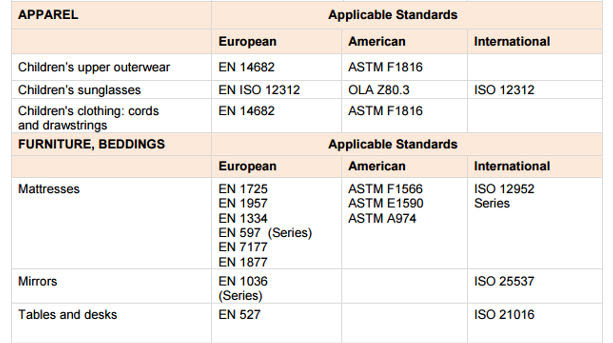
Products within the scope of CGSR are required to comply with European Union, United States or International product regulations:
singapore-regulations
Note: This list can be found in the CGSR Booklet, on the official SPRING website.

How Importers Can Ensure Compliance with Consumer Goods Safety Requirements (CGSR)

Singapore has not developed its own set of product standards. Instead, it refers to EU, US and International technical and safety standards.
Let me explain what this means for your import business.

a. Assessing Applicable Standards

Go back to CGSR booklet and scroll down to page 15. Here you see a list of Children’s products, and applicable regulations.
For each product, SPRING has assigned a set of standards.
For example, as an importer of Bunk beds, you are required to ensure compliance with at least one of the following:
  • EN 747 (EU)
  • ASTM F1427 (US)
  • ISO 9098 (International)
Assuming we choose to ensure compliance with EN 747 (Read more), we can start looking for suitable manufacturers in China, or elsewhere in Asia.

b. Sourcing Manufacturers

When sourcing manufacturers, in any industry, it is crucial to first have identified all applicable product safety standards. Why? Because ‘previous compliance’ is a critical factor when selecting a supplier.
Now that we have identified EN 747 as the product standards we must ensure compliance with, we have a reference point.
For example, we can now start calling suppliers – and filter out all suppliers that cannot prove that they have experience in manufacturing products (Bunk beds) according to the requirements set in EN 747.
While I don’t have data for this specific industry, I can safely assume that most (say 90%) of all manufacturers don’t have experience with EN 747.
Clearly, we should avoid all such suppliers.
But, 10% is not all that bad. Assuming you would need to refer to an obscure Singaporean standard, that no supplier has ever heard of, that figure would go down to zero.
Fortunately, the Singaporean government understands this – but referring to unknown standards is a big problem for importers in Australia and many other (relatively speaking) small markets.

c. Compliance Testing

All major compliance testing companies, such as SGS and Bureau Veritas, offer services, testing products according to EU, US and International standards.
As such, you only need to refer to, in this specific case, EN 747 – and they’ll do the rest.

Electrical Consumer Goods

SPRING lists certain kinds of Electronic products, for home usage, that must comply with either a European Union EN Standard or an IEC International Standard.
The full list can be found on page 17 of the CGSR Booklet.
In addition to the mandatory product standards, Singaporean electronics importers must also ensure that the power plugs are affixed with the ‘SAFETY Mark’.
All power plugs must also be registered with SPRING, with the registration number present in the SAFETY Mark.

‘Can I import any product that is CE marked?’

The CE mark is a European Union compliance mark. It indicates that a certain product is manufactured in compliance with all applicable EN standards.
By putting one and one together, it would be reasonable to assume that all CE marked products are ready to be shipped over to Singapore.
However, doing so could be a grave mistake.
Many products containing the CE mark are not actually compliant with the applicable EN standards. The Singaporean government is, of course, aware of this:
‘Consumers should be aware of the various safety/conformity marks and their limitations. For example, the CE marking is based on a supplier declaration of conformity and there is no assurance that consumer goods marked CE have actually been tested to the relevant EN safety standards.’
Personally, I find it fascinating that the Singaporean government has a better understanding of the complexities surrounding compliance with EU regulations – than the EU authorities have.

Shipping from China to Singapore

Singapore is only 4 to 6 days away from China’s major ports, offering Singaporean importers the benefit of quick and cost effective sea freight from the world’s manufacturing center.
Below follows an overview:
  • Tianjin – Singapore: 7 – 8 days
  • Shanghai – Singapore: 6 – 7 days
  • Hong Kong – Singapore: 4 – 5 days
Singaporean importers also have the option of air freight and land transportation.

Customs Value

Import duties and other taxes (i.e., GST) is calculated based on the Customs Value. In Singapore, the Customs Value equals the CIF (Cost, Insurance and Freight) cost.
Hence, the Customs Value, in Singapore includes the following:
The official Singapore Customs Authority website provides additional information about conditions and alternative valuation methods.

Import Duties

Many products, imported from China to Singapore, are subject to Import duties. The Import duty is normally a percentage, calculated based on the Customs value.
As explained above, the Singapore Customs Value is based on the CIF price. Hence, you can calculate your Import duties as follow:
Import Duty = X.X% x (Product Cost + Freight Cost + Freight Insurance)
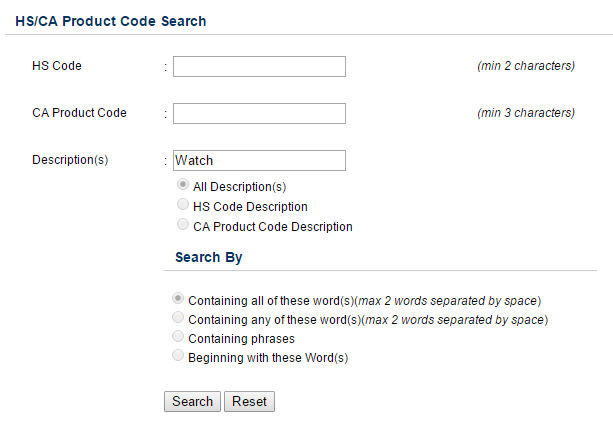
The next step is to find out which, if any, Import duty rate applies to your product. Luckily, the Singaporean government.
customs-search-1
Here, you can choose to specify an HS code, CA Product Code or a Description. In the example above, I just typed in “Watch”.
Let’s see what that gives us.
customs-search-2
The system gives us more than 50 different results, containing the word “Watch”. This includes, for example, the following:
91012100: OTHER WRIST WATCHES OF PRECIOUS METAL CASE OR CLAD WITH PRECIOUS METALS WITH AUTOMATIC WINDING (NMB)
91012900: OTHER WRIST WATCHES OF PRECIOUS METAL CASE OR CLAD WITH PRECIOUS METALS (NMB)
91029900: OTHER WATCHES INCL POCKET WATCHES OTHER THAN OF HEADING 9101 NOT ELECTRICALLY OPERATED (NMB)
The Customs classification of a product such as Watches is very specific, as detailed above. It’s up you to determine which HS code applies to your product, and then ensure that the cargo is declared accordingly.
Now, back to the Import duty rate. You can’t see it in the image, but in the columns on the right, you can read the applicable duty rate.
Here, you can also find a summary of dutiable goods in Singapore.

Goods and Services Tax (GST)

Not all products are subject to import duties. However, all imports valued above $400 are subject to a GST, currently set at 7%.
The GST is added on top of the sum of the Customs value and the Import Duty. However, as the Import duty is often set at zero, you might be able to leave that out.
Below follows an example:
GST = 7% x (Product Cost + Freight Cost + Freight Insurance + Import Duty)

Other Import Taxes and Fees

Alcohol and tobacco products are subject to additional fees, called excise duties. However, in this article we don’t cover Alcohol, tobacco or related products.

Registrations, Permits and Licenses

Before you can get started to import products, your business must go through the following registration steps:
Step 1: Register for Unique Entity Number (UEN) and Activate Customs Account
Step 2: Use the (HS/CA) Product Code Search Engine to confirm the HS code and import duty ate
Step 3: Register for IGB account with the Customs (required to pay import duties and GST)
Step 4: Furnish Security
Step 5: Apply for Customs Import Permit
This process is explained in greater detail on the Quick Guide for Importers, on the Singapore Customs website.

Visiting Suppliers in Mainland China

Singaporean citizens enjoy the advantage of visa free visits to Mainland China, for up to 15 days. Visa-free entry has only recently become available to other nationalities in China, and so far only for transit travelers.


Need more inside? Buy this Guide book just for USD$ 15... you'll get more than what you ever imagine. 
Call / Whatsapp: +60126694217 (Delivery all around the world)


Monday, July 18, 2016

Buying in China and Selling on Amazon – Part 3: Product Guidelines

Importing Insider Newsletter

Stay ahead of your competitors. Get access to our latest content.
 

Contact us now: +60126694217
Get your own Copy...
Become a better person than you are now....

Email us: alveolegame@gmail.com 

The best Guides that you'll ever have...


Amazon Product Guidelines

In this third part of our series on Buying in China and Selling on Amazon, we guide you through Amazon’s Product Guidelines, which are part of Amazon’s Seller Policy.

In part, these terms refer to US product regulations and compliance, but also other, non-regulatory requirements sellers must meet in order to participate.
In this article we explain Amazon’s terms for CPSC product compliance, defective products and counterfeit items.
As always, we also explain how each term relates to the risks involved when importing from China, and other Asian countries.
If you’re interested in reading the first two parts of the series, you find them here:

CPSC Compliance Requirements

“Sellers are responsible for tracking and complying with any regulations issued by the CPSC.”
Compliance with applicable US product regulations is never optional, regardless of whether or not the items are sold on Amazon.com.
However, Amazon’s Seller Policy is explicitly referring to these regulations, clarifying that compliance is the sole responsibility of the seller.
Ensuring product compliance when buying from China is, in my opinion, the biggest challenge faced by American importers. Below I explain the three main reasons:
  1. Only a fraction of the suppliers in China can show previous compliance with US regulations (e.g. CPSIA & California Proposition 65)
  2. It’s often complicated to determine which regulations (often more than one) apply to a certain product.
  3. Ensuring compliance often requires product testing, which is costly.
Ensuring compliance is critical, not only for Amazon sellers, but all importers.
At best, non-compliance results in a forced recall. However, you may also be forced to pay millions of dollars in damages, in case someone is hurt, or if property is damaged.
Before you get started with your imports, you must first confirm which regulations apply to your product, and then limit your supplier selection to those who can prove that have a verified compliance record (e.g. previous test reports, certificates and American buyer references).
In addition, Amazon also requires the seller to comply with all applicable labelling requirements. These labeling requirements are often part product regulations, such as the CPSIA.
Amazon.com provides templates, that enables sellers to add warning labels (e.g. Choking Hazard Warnings) directly to the product page.
Follow the links below to learn more about US product regulations and labelling requirements:

Unacceptable and Prohibited Items

“Items in any of the following conditions are unacceptable for listing on Amazon.com:”
  1. Item does not work perfectly in every regard.
  2. Item is not clean, including signs of mold, heavy staining, or corrosion.
  3. Item is damaged in a way that renders it difficult to use.
  4. Item is missing essential accompanying material or parts. (This does not necessarily include instructions.)
  5. Item requires repair or service.
  6. Item was not created by the original manufacturer or copyright holder. This includes copies, counterfeits, replicas, and imitations.
  7. Item was originally distributed as a promotional copy, promotional bundle, product sample, or advance reading copy. This includes uncorrected proofs of in-print or not-yet-published books.
  8. Any aspect of the item is obscured and not able to be read or viewed because of markings, stickers, or other damage.
    Item is prohibited for sale on Amazon.com.
As any reputable marketplace, Amazon.com has set certain product requirements the sellers must fulfill.
At a glance, these requirements may seem rather simple and easy to comply with, but things always tend to get a lot more complicated when importing from China.
Keep reading, and I’ll explain what you must know about defective items, damages and counterfeits.

Defective items

It’s impossible to completely avoid quality issues when importing products from China. That said, the severity and rate of these defects can be effectively reduced, and controlled, by implementing a comprehensive Quality Assurance (QA) strategy.
It may sound like a monumental task, too big for any small business to implement. In fact, QA is not as complicated as it may seem.
What truly matters is that you implement a QA strategy from the very beginning, and not only in the later stages of the process. Click here to read more about avoiding defect and damaged products when selling on Amazon.com.

Damages, dirt, corrosion and mold

Apart from Quality Issues, transportation damages is another major risk. Many Chinese suppliers lack internal export packaging guidelines. As a result, many suppliers use cheap and substandard export packaging, thereby vastly increasing the risks of transportation damages.
During transportation, your cargo must be able to withstand heavy pressure from other cargo (especially when shipping LCL), shocks, humidity and liquids.
Always provide your supplier with clear export packaging quality requirements, and instruct your quality inspector to include the packaging in the inspection protocol. Below follows some general export packing quality recommendations:
  • Pallets: Wooden ISPM 15 Pallets (1200×900 mm)
  • Outer cartons: 5 layer cardboard
  • Inner cartons: 3 layer cardboards
  • Plastic wrapping: Yes (Outer cartons)
  • Plastic straps: Yes (Shall fix Outer cartons to wooden pallets)

Amazon Anti-Counterfeiting Policy

“The sale of counterfeit products, including any products that have been illegally replicated, reproduced, or manufactured, is strictly prohibited.”
This area is tricky. I think most of you understand that importing fake Gucci bags is not a good idea. However, things are not always as clear cut as obvious fakes VS original designs.
How do you know if that stainless steel coffee pot is an original design, or a replicate of some obscure Danish design company you’ve never heard of?
There’s a reason Chinese manufacturers aren’t famous for being the worlds leading innovators.
The items you see on sites like Alibaba.com are generally referenced products – either based on the products ordered by previous customers, or products that are more or less “inspired” by other brands.
That said, some Chinese manufacturers also develop their own designs, but I dare to say they are a minority.
In fact, we’ve had a few cases when our clients’ products turn up on a suppliers Alibaba.com page. Luckily, Alibaba.com has become much better at acting against IP infringements.
But, Alibaba.com, and other B2B supplier directories, can only act if they the infringement is reported.
While there may not be any cost efficient way to be 100% sure your product is not infringing on another company’s IP, there are still a few precautions you can take in order to reduce your risk of importing counterfeit items:
1. Create your own custom designed product
2. Modify an existing product

Returns, Refunds, & Cancellations

“Here are some situations when you may need to refund, accept returns or cancel orders:”
  1. You can’t fulfill an order.
  2. The customer doesn’t receive your order.
  3. The customer returns an item.
  4. The customer files a credit card chargeback or an A-to-z Guarantee claim.
  5. The customer requests you cancel an order.
  6. The buyer is unable to receive the order at the address provided.
There are various reasons you are forced to refund a customer. Below I explain what you must know about the two most common reasons.

Returns

A customer is not always returning products due to defects or damages, even though quality issues are very likely to result in a high return rate. However, managing quality issues is already covered in this article, so let’s look into how you could end up in a situation where you fail to deliver orders.

You can’t fulfill an order

In order to avoid a situation where you fail to deliver the products, you need to maintain a sufficient quantity in stock. This is often easier said than done.
For natural reasons, importers want to avoid excessive inventory. On the other hand, lead times to restock are long, and prone to delay.
Chinese suppliers rarely keep products “off shelf”, and certainly not products compliant with US product regulations (e.g. California Proposition 65).
Your items must be manufactured before they are shipped, a process which usually takes 30 to 50 days, largely depending on the quantity and complexity of the product.
Then the cargo must be shipped from China to the United States, adding on another 20 to 35 days. In total, you are looking at 2 to 3 months, before the items are restocked, counting from the order date.
However, that is assuming you face no delays whatsoever. But delays are common in China. Maintaining sufficient inventory is complicated, and requires very serious planning.
It’s also a critical Sales Performance signal, that has a great effect on your ratings on Amazon.com. Click here to read more about how you can avoid delays when importing from China and selling on Amazon.

Product Packaging

Amazon’s terms are not limited to the products, but also specify strict requirements forproduct packaging. In most product categories, the packaging requirements are related to whether the item is marketed as new, used or refurbished.
However, certain products must be delivered in a new, and unopened, packaging. This is what Amazon.com requires for wristwatches:
“All watches must come in their original packaging, including all original packaging materials and instruction manuals.”
Also, even if not explicitly referred to in the Amazon.com Participation Policy, all US packaging regulations, and labelling requirements, are applicable.

Before you place an order, you need to confirm which apply to your products, and verify the supplier’s previous compliance record.